
Damp is often misdiagnosed, and this is one of the primary reasons why so many rising damp treatments fail across UK properties. Landlords and property owners regularly commit significant capital to chemical damp proof courses, internal replastering, and decorative reinstatement, only for the issue to reappear within a short period.
This pattern is not coincidental. It is the direct result of treating symptoms rather than identifying the underlying cause. In many cases, what is diagnosed as rising damp is in fact condensation, penetrating damp, or moisture linked to ventilation failure. When the diagnosis is incorrect, the treatment becomes irrelevant.
The financial implications are not insignificant. Beyond the initial cost of works, repeated failure leads to tenant complaints, increased maintenance cycles, and in some cases, legal exposure under housing standards. Damp is often misdiagnosed because the process used to assess it is flawed, overly simplistic, or commercially biased.
Why Damp Is Often Misdiagnosed in UK Properties
Reliance on Visual Indicators Instead of Diagnosis
A common issue is the reliance on visible signs such as staining, flaking paint, or tide marks. While these indicators suggest the presence of moisture, they do not confirm the source. The same visual symptoms can be produced by entirely different mechanisms.
For example, condensation can create damp patches in corners and on external walls, while penetrating damp can cause similar staining following rainfall. Damp is often misdiagnosed when visual symptoms are treated as definitive evidence rather than indicators requiring further investigation.
Use of Inappropriate Moisture Meters
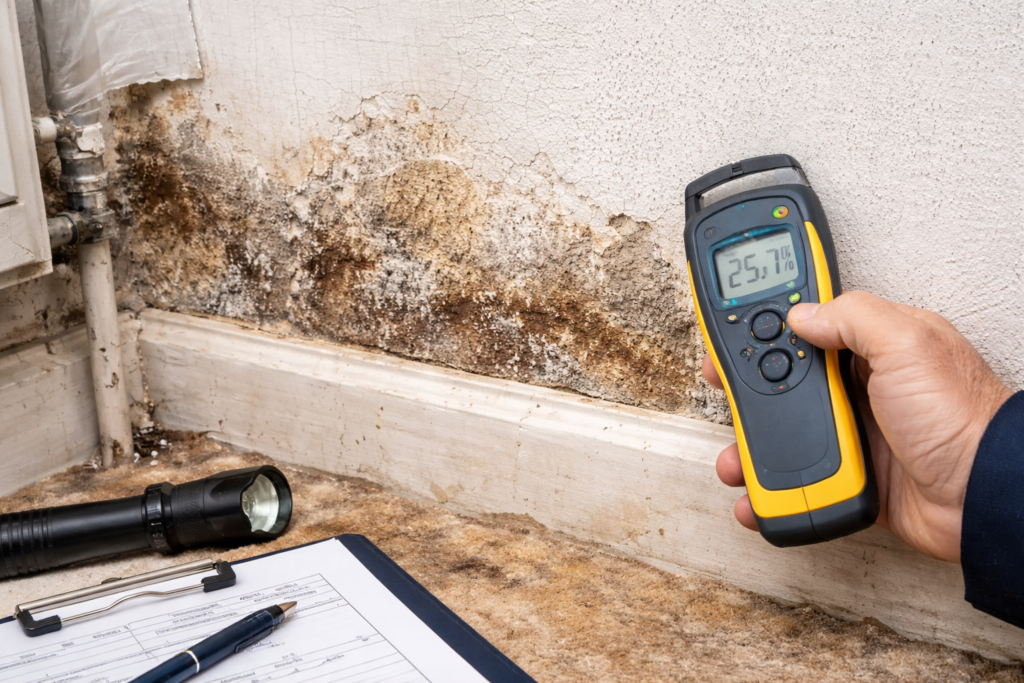
Handheld moisture meters are widely used in damp assessments, but their limitations are rarely acknowledged. These devices measure electrical conductivity, not moisture content in isolation.
Salts within plaster or masonry can produce elevated readings even when active moisture is not present. As a result, readings are often misinterpreted as proof of rising damp. Damp is often misdiagnosed when these tools are used without context or supporting analysis.
Commercial Incentives to Recommend Treatments
In many cases, the same contractor is responsible for both diagnosing the issue and carrying out the remedial work. This creates a structural conflict of interest.
Where revenue is tied to treatment, there is a clear incentive to confirm a diagnosis that justifies that treatment. Rising damp solutions such as chemical damp proof courses are frequently recommended because they are commercially viable, not necessarily because they are appropriate.
Lack of Building Pathology Knowledge
Damp issues are rarely isolated problems. They are often linked to how a building was constructed, how it performs, and how it is used.
Without an understanding of building pathology, including ventilation, thermal bridging, and moisture movement, diagnoses are reduced to generic assumptions. Damp is often misdiagnosed when the wider context of the building is not considered.
Why Rising Damp Treatments Fail in Practice
Incorrect Identification of Rising Damp
True rising damp involves moisture travelling upwards through porous materials via capillary action. While this is a recognised phenomenon, its prevalence is frequently overstated.
In modern construction, damp proof courses are standard, and failures are relatively uncommon. However, rising damp is still widely diagnosed, often incorrectly. When the initial identification is wrong, any treatment applied will inevitably fail.
Treating Symptoms Instead of Root Cause
Many treatments focus on removing visible signs rather than addressing the source of moisture. Replastering, tanking, or applying damp-resistant coatings may temporarily improve appearance, but they do not resolve underlying issues.
If the source of moisture remains, the problem will re-emerge. Damp is often misdiagnosed when the focus is on surface-level correction rather than cause analysis.
Failure to Address Ventilation Issues
Ventilation plays a critical role in managing internal moisture levels. Inadequate airflow leads to condensation, particularly in areas such as kitchens, bathrooms, and bedrooms.
Rising damp treatments do not address ventilation. If condensation is the actual cause, installing a damp proof course will have no impact. This is a common reason why treatments fail shortly after completion.
External Defects Left Unresolved
External factors such as defective guttering, high ground levels, and damaged brickwork can introduce moisture into a building envelope. These issues often go unnoticed or are considered secondary.
If external defects are not addressed, internal treatments are ineffective. Damp is often misdiagnosed when external sources of moisture are not properly assessed or prioritised.
Common Issues Mistaken for Rising Damp
Condensation and Lifestyle Factors
Condensation is one of the most common causes of damp within residential properties. It is influenced by occupancy levels, heating patterns, and ventilation.
Moisture generated from cooking, bathing, and general living accumulates when not adequately ventilated. This leads to damp patches, mould growth, and surface deterioration, often misidentified as rising damp.
Penetrating Damp from External Sources
Penetrating damp occurs when water enters through walls, roofs, or openings. This is typically driven by external conditions such as rainfall and wind exposure.
Unlike rising damp, penetrating damp can occur at any height within a property. However, when it presents at lower levels, it is frequently misdiagnosed. Damp is often misdiagnosed when the vertical pattern of moisture is not properly analysed.
Plumbing Leaks and Internal Moisture Sources
Leaks from internal pipework, bathrooms, or appliances can create localised damp conditions. These are often intermittent and may not be immediately visible.
When damage appears on walls or floors, it can be incorrectly attributed to rising damp. Proper investigation is required to identify whether the source is internal rather than structural.
What a Proper Damp Diagnosis Should Involve
Full Building Assessment
A structured assessment should consider the entire building, not just the affected area. This includes external elevations, roof condition, drainage, and internal layout.
Damp is often misdiagnosed when inspections are limited to a single wall or room. A comprehensive approach ensures all contributing factors are identified.
Moisture Mapping and Pattern Analysis
Moisture does not behave randomly. It follows patterns influenced by structure, materials, and environmental conditions.
Mapping these patterns allows for accurate identification of the source. Isolated readings or observations are insufficient. Damp is often misdiagnosed when pattern analysis is not undertaken.
Identification of Root Cause
The objective of any damp survey should be to determine why moisture is present. This requires linking symptoms to underlying mechanisms.
There may be multiple contributing factors, such as poor ventilation combined with minor external defects. Without identifying the root cause, any proposed solution remains incomplete.
Conclusion
Damp is often misdiagnosed, and this is the core reason why rising damp treatments fail across UK properties. The issue is not simply the effectiveness of treatments, but the accuracy of the diagnosis that precedes them.
Applying solutions without understanding the cause leads to repeated expenditure, ongoing disruption, and increased risk. For landlords, this extends beyond cost into compliance and tenant management challenges.
A survey-led approach removes uncertainty. By focusing on diagnosis rather than assumption, property owners can implement targeted solutions that resolve issues at source and prevent recurrence.